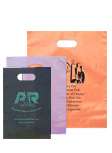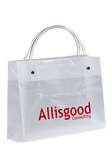

Introduction to flexo
shopping bag art for the bag purchaser and packaging sales person
In our experience, most custom printed bag projects get started with
people not trained to get the art ready: the person needing the bag and
the person selling the bag. It is important to have a basic
understanding of what is needed to get a custom printed project off to a
good start. General estimates for plate costs and lead times provided in
quotations and throughout general conversation with our Customer Service
and Sales staff are based on receiving correctly prepared B&W or digital
art work. For further clarification, the following items are not
"correctly prepared art" that fit into generally quoted costs and lead
time estimates:
|
Business cards,
letterheads, photocopies, faxes, etc. |
Digital files
supplied on media other than we can read |
|
B&W requiring
enlargement more than 150% |
PC - rather than Mac
- platform digital files |
|
Scanned images
requiring enlargement more than 150% |
Overall designs not
positioned on a Aplasticbag.com bag template |
|
Previously printed
paper bags or other packages |
Films and/or plates
not to our specifications |
|
Multicolor designs
with tight register and trapping requirements not prepared to in
line flexo specifications |
Designs with
halftones and flat screens requiring adjustment for in line
flexographic printing |
This is not to say it is impossible to start with these materials - only
that it will cost more and take more time.
Introduction
for the graphic artist
We see that most of the artists and designers preparing work for a
shopping bag have a background in offset lithography or gravure, not
flexography. If there is some flexo experience, it is in narrow web for
labels, and not the wide web used for packaging. Wide web flexo is a
world apart from offset litho and narrow web flexo. These Art
Guidelines are designed to function as a very basic "how to" primer
for designers and artists working on new flexographically printed
shopping bag projects. The Guidelines should help to get the art
done correctly the first time, minimizing the prep time and costs to get
shopping bag art ready to run. Please do not hesitate to call or write
Aplasticbag.com if there are any questions before starting a new
shopping bag design.
In line
flexographic printing
Flexographic printing is a relief printing process that uses
photopolymer plates .112 thick. In many respects flexo is like printing
with big rubber stamps. At Aplasticbag.com printing is done in line with
bag making. Rolls of paper are unwound into the bag machine, printed up
to three colors, handles applied, side folds formed and seam glued,
bottom folded and glued, and then individual bags are cut away from the
web and packaged for shipment. The ability to reproduce fine lines,
screens and halftones is limited compared to litho, gravure and narrow
web flexo.
Ink color matching
and proofing
We can custom match submitted materials, or use PMS color
specifications. When using PMS, please specify colors from the Uncoated
"U" section of the book or Coated "C" section of the book as
appropriate. If we are reproducing a PMS color on uncoated paper that
has been reproduced on coated paper previously, we suggest the end user
and/or artist specify a PMSU shade that best matches the coated paper
version when submitting the art and order. Aplasticbag.com prints on
Natural Kraft, White Kraft, Oatmeal and Claycoated papers. All inks are
water based.
We send ink drawdowns for
PMS colors on White Kraft and Claycoated only when requested on P.O., or
when there are traps and/or overprints that in our judgment should be
approved prior to production. Note that due to our production process,
there is no trapping or overprinting on Claycoated paper. We send ink
drawdowns for PMSU matches on Natural Kraft and Oatmeal, as well as for
all custom matches to colors other than PMSU numbers. Approval is
required before bags can be produced.
Design templates
and logo positioning, bag proofing
Unless the design is no more than a spot imprint, the designer should
have a template before starting artwork. A tool enabling artists to
quickly construct their own templates appears on the back side of this
sheet.. Templates can also be requested from Tulsa Customer Service, or
found as downloadable, executable files in Freehand and Illustrator at
this site. See link below, or in Site Directory at left, but
please finish reading these Art Guidelines first.. Orders for
spot imprints not on a template must include logo positioning
instructions on the P.O., e.g., center left to right, 3" up from bottom.
All bags must be proofed, usually as folded bluelines. Color keys may be
furnished when tight register and complicated trapping is involved. Bag
proofs must be approved before bags can be produced.
Line width
Minimum positive printing line width is two (2) point. The minimum
reverse printing line width is (3) point.
Type size
Minimum positive printing type size is ten (10) point. The minimum
reverse printing type size is twelve (12) point bold. These guidelines
are subject to review with serif type faces, and with designs including
heavy areas of broad solid along with small type in the same color. In
these circumstances the type may need to be larger and/or bolder.
Register tolerance
and trap
Wherever two colors meet, a 4.5 point trap - 1/16" - is required to trap
the colors. Where two colors are adjacent and the designer does not want
them to touch, there should be a minimum of 4.5 points of space between
the two colors. As a general rule this register tolerance precludes the
use of two overprinting colors to create a third color, whether with
solids or screens; and when attempted would need a third color such as
black to outline the shape. Note that due to our production process,
there is no trapping or overprinting on Claycoated paper.
Screens and
halftones
The line screen rulings used at Aplasticbag.com are 50 line and 45 line.
Maximum Photoshop resolution needed is 125 - save space! Due to the
differences between how wide web flexo and offset litho reproduce
screens and halftones, we request the opportunity to review the design
elements to provide specific production art direction as early in the
planning process as possible. Halftones must have strong contrast, as
must steps between manually selected screen values of the same color.
Subtle tone variations will not reproduce.
Formats
Aplasticbag.com can accept for artwork
1. Camera ready mechanical or scanned (raster) digital images that do
not have to be enlarged more than 150%.
2. .004 right reading emulsion up negatives (RREU). Please do not try to
furnish negatives for designs with screens/halftones.
3. .112 photopolymer plates, .050 relief. Please do not try to furnish
plates for designs with screens/halftones.
4. 3.5" floppy disks for Macintosh. Please furnish confirming hard copy
- scaled laser or ink jet print, etc. - with disks.
5. 100 megabyte Zip disks for Macintosh. Please furnish confirming hard
copy - scaled laser or ink jet print, etc. - with disks.
6. 44, 88 and 200 megabyte Syquest drives for Mac. Please furnish
confirming hard copy - scaled laser or ink jet print, etc. - with disks.
6. CD for Macintosh. Please furnish confirming hard copy - scaled laser
or ink jet print, etc. - with disks.
7. As email attachments to art@Aplasticbag.com. Please fax confirming
hard copy - scaled laser or ink jet print, etc.
8. Mac Freehand and Illustrator files are preferred. Quark is acceptable
if these are not available. PC file capabilities are limited.
9. When submitting artwork on disk, all screen fonts, printer fonts, and
graphic source files must be furnished with the layout.
|